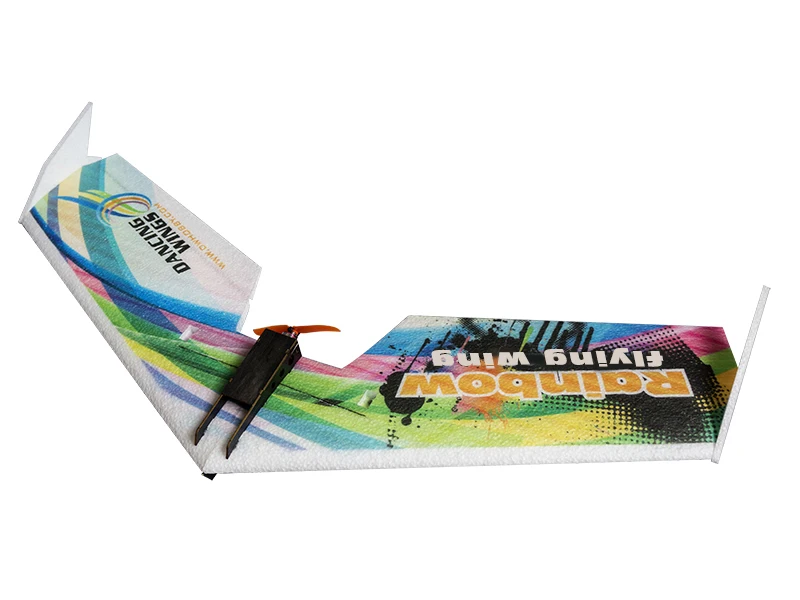
Hacker Hot-Wing Evo 1000
When I first saw the Hacker Hotwing online I liked it. It certainly was a good value. It was the first plane I built from the ground up., and it was the first plane that I bought the wrong parts for. It mentioned desired KV but no real mention of motor size. I ended up with d3536, a motor that was for a plane that weighed four times more than the Evo 1000. As my buddy Charlie says "You're only new once." When the box for the Evo 1000 arrived it was much lighter than I imagined. I threw it on a shelf and promised to get back to it. About a month ago I did get back to it. The instructions weren't very clear, so I ended up sending emails to the owner of the company. He was the one who told me about UHU Por and did answer my questions about the build. There were some steps to this day I still don't understand and a few changes I made before the first flight. But overall, I am beyond thrilled with this plane!
A smooth Delta Wing
I have a Radian, it has controls on the rudder and elevators. In other words it goes up and down, left and right. An aileron plane is a different flying experience. It's capable of axis rolls, flying inverted, and more of what my friend Charlie calls a real flying experience. Delta Wings don't have a tail, so the rudder and elevators are out of the equation. It only has two ailerons. Thus, when you push left on the stick the left aileron (looking at the plane from behind) goes up, the right one goes down. The opposite happens when you push right, Pull back on the stick both ailerons go up, push forward they go down. It sounds so simple, but getting your radio to cooperate is like solving the Rubik Cube.
This is by far one of the smoothest, most forgiving delta wings around. Delta wings can be very temperamental, especially around 600mm.

How it flies
I know you will want to go big with this plane opting for big motors, large speed controller and heavy servos. Seriously, keep it light. If you do, you literally toss this thing with your left hand. Simply power up to around 50% and toss. Hold the controller with your right hand start flying. The first 20 feet it's somewhat close to the ground and soon it's climbing. Right away you'll feel like you're in control.
Instead of BSing you about some mystical religious experience of flying the plane I thought I'd tell you exactly how it handles in realistic terms. Once you're in control the plane climbs nicely. I find that close to half throttle takes her up and away at a decent climb. It's not 3D climbing rates but it's stable. At my local park I have a pattern I fly which is to get up to around 120 feet then bank left and come back around. I have a TekSumo which is 10% smaller at 900mm with a stronger motor. At this point is where I see a huge difference between the planes. The TekSumo has a stronger motor and if I don't change my angle of attack while making the turn the TekSumo can fall out of the turn into a spin. The Evo-1000 hangs in there making a smooth first turn.
The plane is very maneuverable, much better than you would think a 1-meter plane would be. If the plane starts to sink quickly you have it a bit too nose heavy. CG isn't touchy on this plane, but it does make a difference. If you find that you're having to manage the controls too much on the first flight, inch back your battery to the CG. With my 1500mAh 3S I actually place it perpendicular to the CG and its best about an inch above the CG line. The plane is very predictable, it can handle a bit of wind with grace, but it's not really meant for gusts over 10MPH. If the wind gets to be a bit too much it will remind you of a guppy swimming aginst a strong current. When you cut the power it should gilde. That makes this plane very predictable and easily controllable. The smooth , predictable drop from 100 feet means that you can precisely set this plane down. Thus, if you're flying on a good sized front yard or a small park you can set this plane down in something as small as 100 feet as long as you have good clearance. The TekSumo needs to burn off speed before it lands. The Evo-1000 just seems to drop at a reliable pace. So, when it's a couple of hundred feet out you have a good idea where it will land.
The plane does loops and axis rolls. So, it's appealing to someone who has more advanced skills. It handles well even at very low altitudes. I like flying it close to the ground, turning close to the ground and then kicking up the power so that it climbs out of the park well before the parameter trees get in the way.
On calm mornings I put this plane up around 300 feet and let it troll around the heavens at 20% power. I a getting around 30-minute flights on 3S 1500mAh batteries. Part of the problem with being a stable plane is that it's not a stunt plane. I have planes you need to be on top of every second or they will find the nearest tree to land in. They are great stunt planes, but nerve racking to fly. Part of what makes The Evo 1000 an enjoyable plane is that you don't have to micromanage it.
My skill level is very mixed. I have many, many simulator hours. They have been useful for me. But, when it's reality with real trees the plane can get stuck in I am a lot more conservative. This plane is perfect for me. I would rate my skill level as an advanced-beginner. One other thing I enjoy about this plane is that it doesn't have a cutout for a battery by the nose, though the instructions call for it. I find that the lack of foam makes the nose cave-in or tear easily during crashes.
Suggested pilot skill level.
The Evo-1000 is a very forgiving trainer. If I were going to let someone fly on a buddy-cord with me, this is the plane I would grab. It's small enough to throw into the back of the car without much fuss. I can see myself taking it out visit friends and letting them fly it at their local park. People with more advanced skills may enjoy it for its easy flying characteristic
Charlie give it 5 stars!
My morning flying plans with Charlie (a very skilled RC pilot) got cut short when we discovered a stripped servo in the Radian. Charlie lives about 45 minutes away so I decided to take along planes that I had recently built. Of all of them the one I felt the most confident about was the Evo-1000. Charlie said "Get it ready!" Almost like a military inspection I had the plane ready, he looked it over, didn't bitch a whole lot. The CG was right, the plane was ready. He threw it, fired it up and within a minute there was a smile on his face. "This is a five-star plane!" It wasn't a perfect plane, the motor was 1000 KV wasn't a screamer. Charlie found it to be very predictable and handled very well. Though he's an actual pilot and has built untold hundreds of planes he enjoys planes the best that don't need to be micromanaged.
The Build
 |
| The building process on my messy workbench. |
When the kit showed up in the mail it was about 1/10th of the weight that I thought it was going to be. The box weighed nothing, it almost felt like was empty. The instructions left something to be desired, but most do. The instructions were better than most though a few steps still have me scratching my head. Once you've built a few foamies you almost don't even need instructions. The instructions were in many different languages and at least one step was repeated twice. For the most part you're just gluing the cores together, burying a spar, putting the winglets on, the servo horns, and strapping on electronics. There are "vortex generators" on the plane. They look like fins. They improve the aerodynamics of the wing. The control surfaces are a very nice size as well. I do like how the plane is made. Just be certain to get your own control horns and some Dubro EZ connects. I am also going to redo the plane in the near future and get rid of the carbon rods used as control arms. I am not pleased about how much the rods flex when moving the servos. I also like the graphics on the plane. Using UHU Por it took me a few days to put this plane together spending a little time here and there. As for storage, it is said that the plane should be hung by its prop.
One meter Delta Wing
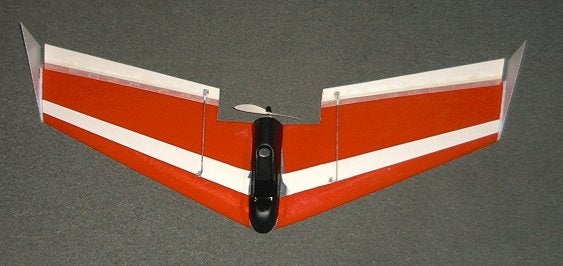 |
| The original 4 foot Zagi 400X from the mid-1990s. |
The build Quality
I think it repeats mentioning again this plane is very light. Though it's a light grade of EPP foam it's thick. The plane feels like a Nerf football and Morey Boogie Board got together and decided to make a plane. This plane is more like the old school Zagi in shape than the 1-meter planes coming out of China. It has a nice, fat leading edge. It's much thicker than the cheap 1-meter planes from China. It's a more robust build which can take a decent motor. I haven't put something insanely sick on the back such as a 3536 with a 5A Lipo battery in the front. From what I've read, once you start loading the wings down with heavy gear it loses part of its charm. Also the wing load won't support the weight with the thin spars that come with the plane. You can also break the plane. I do like that the plane isn't pre-cut with a battery compartment for a battery that doesn't fit. I simply don't like the idea of cutting foam near the nose of a plane. When you crash, this is the first area to tear. I simply strap my battery to my plane and use Velcro to hold it in.
My parts:

Motor: BR2212- This is the second motor I ordered for the plane. The specs were rather vague and I had no clue what to order. So, I ordered a D3536 with 60A speed controller. That's four times the weight of the BR2212. The motor I put in the plane was a BR2212-1000KV. There are many different BR2212s, this is the one I bought.
This little motor is actually really great, though it was designed for a 10" prop in mind it works perfectly fine for the Evo-1000. The plane specs out at least a 1000KV motor. You can go with a smaller prop and a higher KV motor if you want to push a bit more speed. I like the slow flyer big prop however.
Speed controller- I used a Plush 30 for the speed controller. I've recently switched over to Skywalker speed controllers, however. Why 30A? It's what I had laying around. The motor can get away with a 20A ESC. If this is going to be a special plane for you and you're going to keep it around for a while then, by all means, spend the extra $ 7and get the Hitec ESC from Omni Models.
Servos- I threw in the generic Towerpro 9G servos. They work great. And if one breaks I'm only out a couple of bucks. I have recently switched over to the metal gear servos. They are a bit nicer but a lot more expensive.
The prop is a 9" APC. I believe it's the 9060 EP E is for "electric" and P is for "Pusher." Here's the link from Omni Model. I would suggest an 8x4 with a 1400kv motor however.
The radio- Select your favorite. I use both FM and 2.Ghz. By now you probably already have a radio system.
Battery- LiPo 1.5A 3S 11.1V. With this battery, I am getting around 30-minute flights. The plane isn't tail heavy with the light motor so I find that I am pushing this battery closer to the CG than the nose.
The plane- I bought the plane from OmniModels with my own money- Here's the link to what I bought-
Control Horns-I know my experience with RC planes is limited. If I can teach you anything it would be to get yourself a whole lot of good control horns. Throw away the ones that come with the plane. I'm sorry, I have to bitch here for a moment. Across the board the control arms, control horns and ways of linking the arms to the servo arms are bad from most models I've seen The only thing that is about as bad are the ways that the motor mounts to the plane. I really think that Omin Models should have a set of parts that they sell on the side of this plane as an upgrade. The motor mount on the plane isn't bad but the rest needs an upgrade for sure.
Buy UHU Por- Dealing with the owner of Hacker he told me to not mess around with anything else. This is German glue, and I have to say it's simply amazing. I bought mine from Amazon. If you read the UHU Por Review I wrote I mentioned it's not shipped from the USA. At least not at the time of writing this. Amazon took about a week to get it to me.
My overall evaluation

I give the flying characteristics 5-stars. But the build quality gets knocked down a star with the cheap parts. The EPP foam cores are great. I highly suggest this plane for any beginner, intermediate pilot. Just do yourself a favor and get some bettter parts.
Suggested upgrades
Aside from the control arms and control horns I am going to make a suggestion for reinforcing the plane. The plane could benefit from a real 2mm or 3mm carbon rods running horizontally from wing to wing near dead center. If you order the spars from China they come in 500mm lengths. If you order them in the states you can get them in 1000mm lengths. You may need one in a 1000mm length to go from one wing to another. The plane isn't floppy when you hold it, but this reinforcement is something I plan to do after a year or two as the stress of flying takes its toll. If you're prone to crashing a lot you may want to run 2mm carbon spars buried in the leading edge to help keep together. As the instructions suggest I keep my plane hanging when not in use
One last thought
Foamies are resilient planes. You can be somewhat abusive to them and they will bounce back. But I don't see them as forever planes. The hinges will come apart over time and it will start to sag even with the best care. Thus, when you find a plane you really like, it may be worthwhile to buy the model again and put your parts on the newer plane. I can see myself ordering another Evo-1000 in a couple of years. This isn't a TekSumo. It's not begging for hot rodding. I really don't see myself outgrowing this plane. I very much enjoy flying it.
OminModels
I've had the best shopping experience with OminModels. They are now my "Go-To" supplier for RC planes and parts.